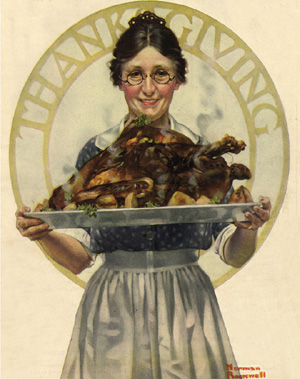
"Thou shalt thank the Lord thy God in all things."

John Howland came on the Mayflower as a servant. One night at sea when the “winds were so fierce and the seas so high . . . a lusty young man called John Howland was . . . thrown into the sea; but it pleased God that he caught hold of the topsail halyards . . .” The crew rescued him with a boathook. And while many pilgrims died, including John Howland’s master and his master’s wife, John Howland lived to marry and have ten children. H.U. Westermayer said, “The Pilgrims made seven times more graves than huts. No Americans have been more impoverished than these who, nevertheless, set aside a day of thanksgiving.”

Abraham Lincoln instituted the Thanksgiving Proclamation of 1863 while we were in the middle of a bloody war. There was much to be discouraged about, but he chose to focus on expressing thanks for our blessings. He said America needed to be grateful that no other nations had taken advantage of her in her weakened state while internally fighting. He said America’s prosperity was a “gracious gift of the Most High God, who, while dealing with us in anger for our sins, hath nevertheless remembered mercy.” He suggested that it was fitting and proper for the American people to solemnly, reverently and gratefully acknowledge that.
Both John Howland and Abraham Lincoln had much about which to be discouraged. But they chose to be grateful. Now that is thanks giving.
Hundreds of years later, science has proved that practicing gratitude makes us healthier. Robert Emmons, PhD, and professor of psychology at the University of California, Davis conducted a study on the affect of gratitude on people. He used three groups in his study. The first group was assigned to focus on hassles or things wrong in their lives. The second group was asked to focus on things for which they were grateful or enhanced their lives. The third group focused on ordinary life events. It was discovered that those who found something to appreciate every day were less materialistic and less likely to see a connection between happiness and possessions. Those who consciously expressed appreciation were also
• more empathetic
• more helpful
• felt better about their lives
• were more optimistic
• were more energetic
• were more enthusiastic
• were more determined
• were more interested
• were more joyful
• exercised more
• had fewer illnesses
• got more sleep
• were more likely to have helped someone else
• had clearer thinking
• had better resilience during tough times
• had a higher immune response
• were less likely to be plagued by stress
• had longer lives
• enjoyed closer family ties
• had greater religiousness
• experienced more joy
It appears that gratitude pays again and again and again.
Of course it would be good for us . . . it's a commandment.